
Objectives: How do rocks change over time?
- Lesson Materials: (updated Jan. 4, 2026
- Rock Cycle Comic Strip Lesson Plan
- Science Spot has a handout on her site (pdf) for the 12 comic panel and more info here
- Modified – students will draw only one detailed scene from their journey (Google Doc view only) make a copy to edit
- Laminated Station Cards
- Stations as Google Slides – view only, make a copy to edit
- print slides and place into plastic sleeves or laminate
- For 2016-2017 I updated some of the stations to have more variety in the outcomes and introduce some higher level concepts for my 6th graders to lead into our unit on Plate Tectonics
- Stations as Google Slides – view only, make a copy to edit
- Dice: 2-4 at each station
- Pencils
- Colored Pencils
- Rock Cycle Comic Strip Lesson Plan
- May 13, 2020 – Updated for Distance Learning
- Modified to be used on Google Classroom – students will be able to roll virtual dice and view slides on presentation mode, then advance to different slides based on their roll.
- Interactive Google Slides: (View only, make a copy to edit)
- Google Doc: (View only, make a copy to edit)
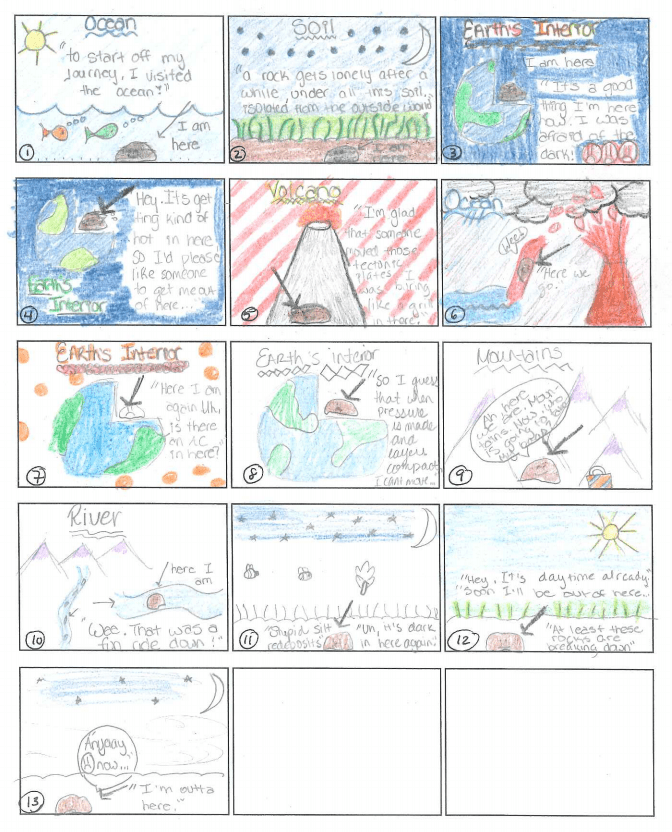
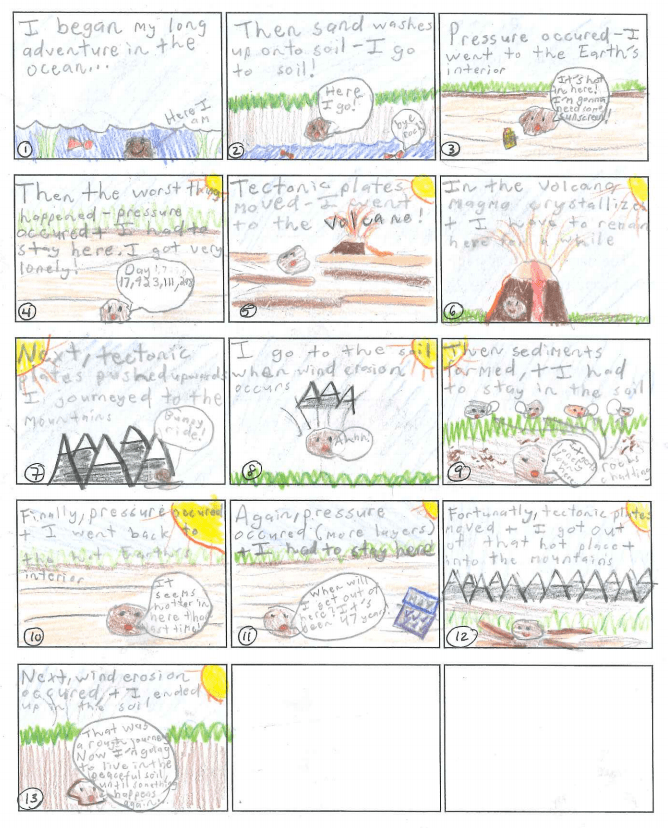
Click on the samples of student created comics posted below for inspiration:



Tips for running the lesson:
- Use this lesson after introducing the Rock Cycle to students.
- Having 2-4 dice at each location allows multiple students to be at each station at the same time. In the past when I used the paper dice that come with the lesson, it took time for each student to write down the outcome from the dice. Having the outcomes on the station cards helps speed things up.
- Set up stations around the room, depending on the number of students you have, you can make multiple stations for each one.
- For example, for the Soil Station or the Earth’s Crust & Interior Station, you can have more than one of each to spread students out around the room. They get a lot of traffic.
- If students get ‘stuck’ at a station, explain that they can be stuck in the Earth’s Interior for millions of years and their whole comic would be just that one station, but allow them to ‘roll out’ of a station if they are there for a 3rd time.
- For example – A student will end up at the Soil Station and roll “Sediments Being Formed Remain Here” and write that on their handout. Then they will roll “Sediments Being Formed Remain Here” again, and write it down. If on the 3rd turn they roll “Rocks Break Down, Remain Here” have them roll again until they get something different. They may then get “Flooding Occurs, Go to River” and write that down and go to the River Station. They may end up back at the Soil Station on a later turn, but that is OK. They will visit some stations more than others.
- Once students are done with their journey, check over their work and then have them start their comic strip. They might need some tips on how to draw certain geological processes.
- I have used this lesson for many years and the students really enjoy making their comics and come away with a better understanding of how rocks change over time.


 Middle School Science Lessons
Leave a reply to Anonymous Cancel reply