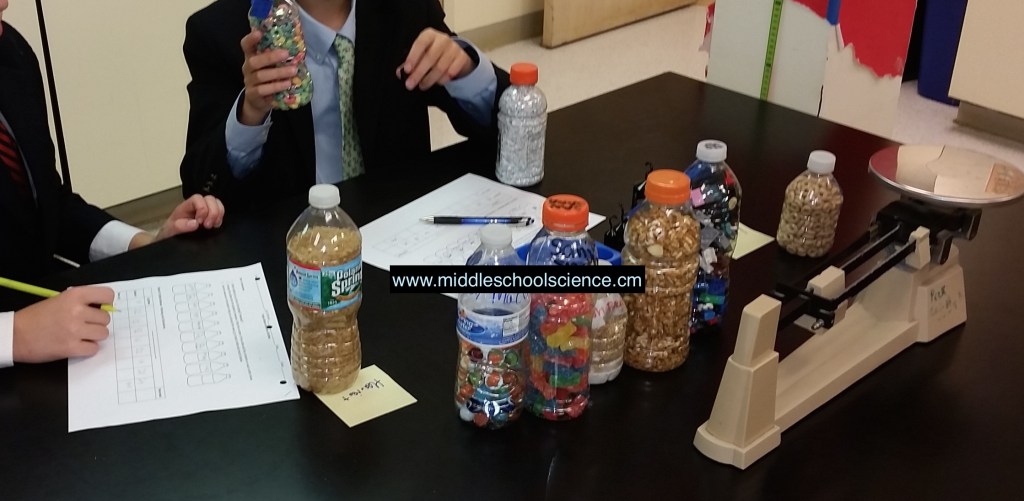

Objectives: How can we use a triple beam balance to find the mass of ‘stuff’
Materials
- Single Serving Size (1L or less) bottles filled with various DRY items
- students brought in materials of their choice over the course of 1-2 weeks
- Triple Beam Balance (TBB)
- Mass Set
- Google Doc – Instructions and Data Collection
- Google Sheet – for graphing
- (make a copy of each to edit and share with students) (Updated 12/22/25)
- There are different formats to collect data in the handouts
- (OLD) Student Handout (Triple Beam Balance Bottles pdf)
- (make a copy of each to edit and share with students) (Updated 12/22/25)
Procedures – Part 1
- Over the course of about 2 weeks, students brought in a variety of bottles filled with DRY items of their choice. I ended up keeping them and reusing them each year.
- Why dry?
- prevent mold
- prevent leaks/spills
- Why dry?
- Provide each lab group with an assortment of bottles
- I mixed up the bottles so that each group had a variety of masses, bottle sizes, and contents to measure
- Students will arrange the bottles from lightest to heaviest by making observations and comparisons.
- no TBBs yet
- They will record the order of the bottles and their contents with #1 as the lightest and #10 the heaviest on their handout
- my groups used 9 bottles, but there is room on the handout for 10
- Using the set of masses, they will estimate the mass of each bottle by holding a bottle in one hand and a mass in the other hand, recording their estimations on the handout
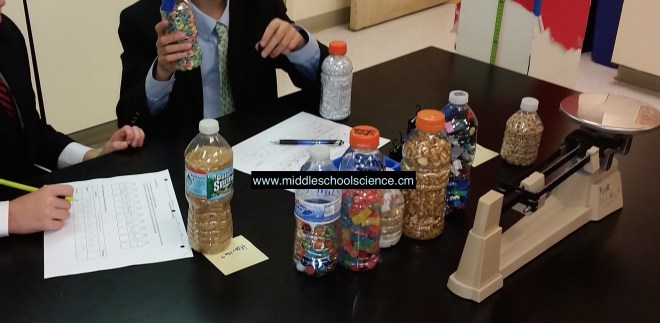
Procedures – Part 2
- Using the TBB they will record the actual masses of the bottles
- Then they will rank the bottles from lightest (#1) to heaviest (#10) and compare their estimation to the actual masses. How close were the estimations to the actual masses? Did they place the bottles in the correct order?
Results for the bottles in our class:
| Mass in grams | |||
| Bottle # | Class 1 | Class 2 | Class 3 |
| 1 | 126.9 | 127.6 | 126.9 |
| 2 | 72.6 | 72.8 | 72.9 |
| 3 | 29.6 | 29.6 | 29.6 |
| 4 | 438.6 | 438.3 | 438 |
| 5 | 202.5 | 202.8 | 202.1 |
| 6 | 185 | 165.9 | 166 |
| 7 | 62 | 62 | 63.1 |
| 8 | 302 | 301.8 | 301.5 |
| 9 | 223.7 | 223.7 | 224 |
| 10 | 600+ | 600+ | 610+ |
| 11 | 67.4 | 67.5 | 67.1 |
| 12 | 252 | 251.6 | 251.8 |
| 13 | 410.5 | 410.5 | 410.1 |
| 14 | 281.1 | 280.6 | 281 |
| 15 | 337 | 336.6 | 336.5 |
| 16 | 222.8 | 222.7 | 223 |
| 17 | 70 | 70.2 | 70 |
| 18 | 37 | 36.7 | 36.43 |
| 19 | 185.2 | 185.3 | 185 |
| 20 | 86.5 | 86.5 | 88 |
| 21 | 140 | 140 .2 | 140.1 |
| 22 | 50 | 49.9 | 49.1 |
| 23 | 73.5 | 73.1 | 73.3 |
| 24 | 55.1 | 51.4 | 54.9 |
| 25 | 26.35 | 26.5 | 27.5 |
| 26 | 406.6 | 405.9 | 406 |
| 27 | 192.3 | 192.4 | 192.3 |
| 28 | 330.5 | 330.8 | 330.9 |
| 29 | 464.4 | 464.7 | 465 |
| 30 | 194.9 | 201.3 | 195 |
| 31 | 60 | 59.7 | 59.1 |
| 32 | 176.8 | 177.1 | 168.8 |
| 33 | 35.4 | 35.8 | 33 |
| 34 | 99.9 | 99.9 | 100 |
| 35 | 402.7 | 402.5 | 402.5 |
| 36 | 187.1 | 187.3 | 187.1 |
| 37 | 323 | 318.4 | 318.4 |
You can also use these bottles as part of your density unit, see my blog entry for more information.
 Middle School Science Lessons
Comments are welcome!