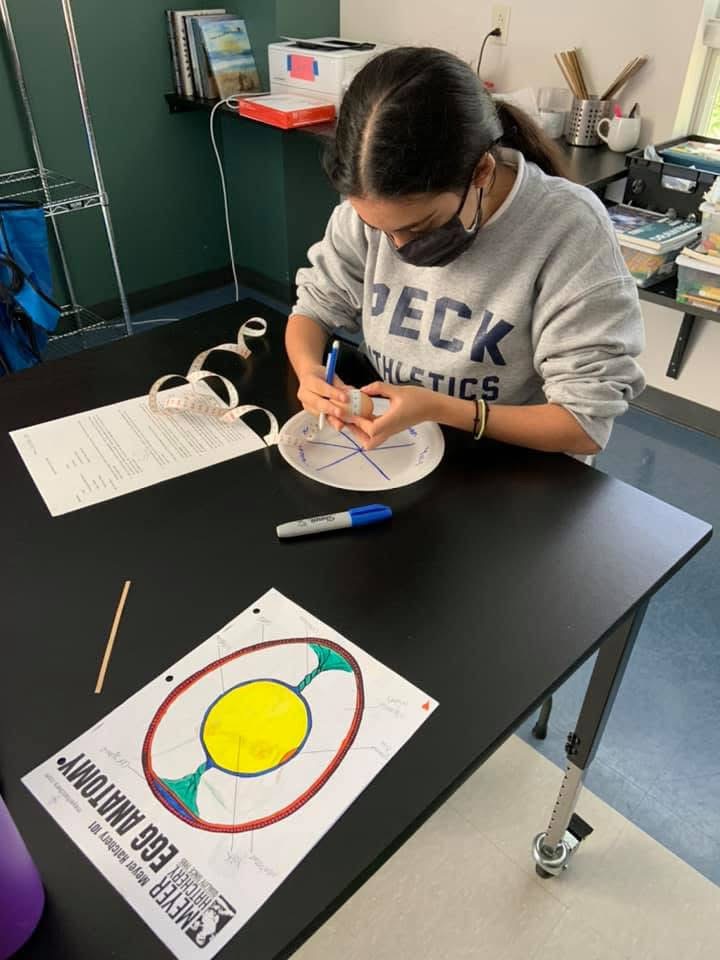
Objectives– students will collect and analyze egg data, learn the parts of an egg, and compare how chicks and humans develop.
When I taught 7th grade, I had a student that brought in eggs from her farm and they were beautiful shades of pink, green, tan, brown, and blue. Most students have only seen the white or brown ones in the store, so they were excited to pick out a color of their choice.
- Egg Diagram Resources:
- Egg coloring page – how are the parts of an egg similar to placental mammals? We read, colored, and discussed this handout together as a class
- Egg Digram – there is a pdf available on this page to label and color, we did this together to learn the parts of the egg before the lab and used as a guide during
- Egg diagram and definitions – nice reference resource
- The different parts of an egg – super detailed reference reading!
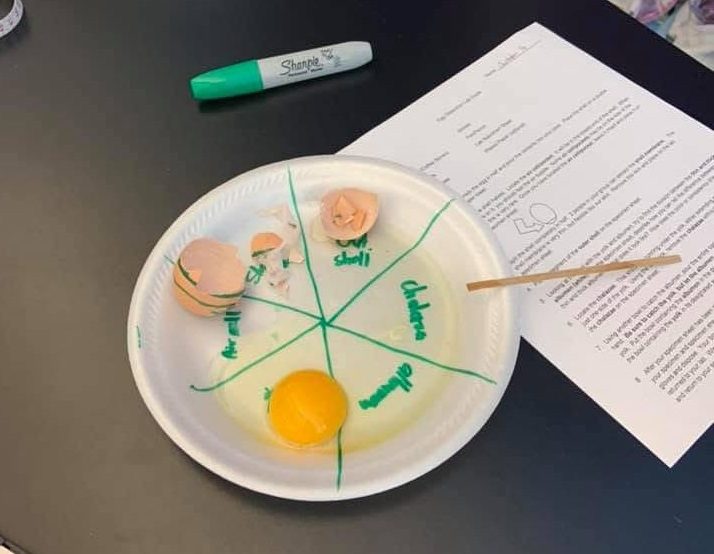
- Egg Dissection Directions – (pdf) I used a paper plate for each student and before they started the dissection, they used a sharpie to label the parts of the egg they were looking for onto the plate.
- Egg Dissection: another resource with a pdf available
- Google Sheets for Data Collection (make a copy) – Is there a relationship between the diameter and the length of the egg?
- students will use a measuring tape to find the circumference of the length and the width of the egg in mm.
- Find the widest part of the egg, this will be the “equator”
- Using a sharpie, draw a line around the equator.
- Find the longest part of the egg, this will be the length of the egg
- Using a sharpie, draw a line from the point of the egg to the base of the egg and around back up to the point.
- Using a measuring tape, follow the lines and record each measurement in mm
- Find the widest part of the egg, this will be the “equator”
- students will use a measuring tape to find the circumference of the length and the width of the egg in mm.
Extension Lesson:
Odyssey of Life Activity – (pdf) Can you determine the correct order of developmental stages for a fish, chick, pig, calf, and human? My students enjoyed this cut and paste activity. They worked with a partner and we took turns guessing the embryos, starting with stage 3, and then glueing in each correct answer.
Common Past, Different Paths -📽 this ties in the activity above: “This video from NOVA: Odyssey of Life, captures the shared ancestry of animals with backbones.”
I also showed the videos below on animal development when we had extra time at the end of classes:
 Middle School Science Lessons
Comments are welcome!